Washing glassware in a Quality Control (QC) Microbiology laboratory requires a standardized process. Because trace residues of detergents, heavy metals, or alkaline compounds can inhibit microbial growth, distort assay readouts, or introduce false endotoxins, cleaning must yield physically, chemically, and biologically clean glass.
Washing Work flow
1.Pre-Soak & Decontamination
Used/Infected Glassware: Autoclave biohazardous cultures (e.g., spent agar flasks, broth tubes) at 121°C for 30–60 minutes prior to cleaning.
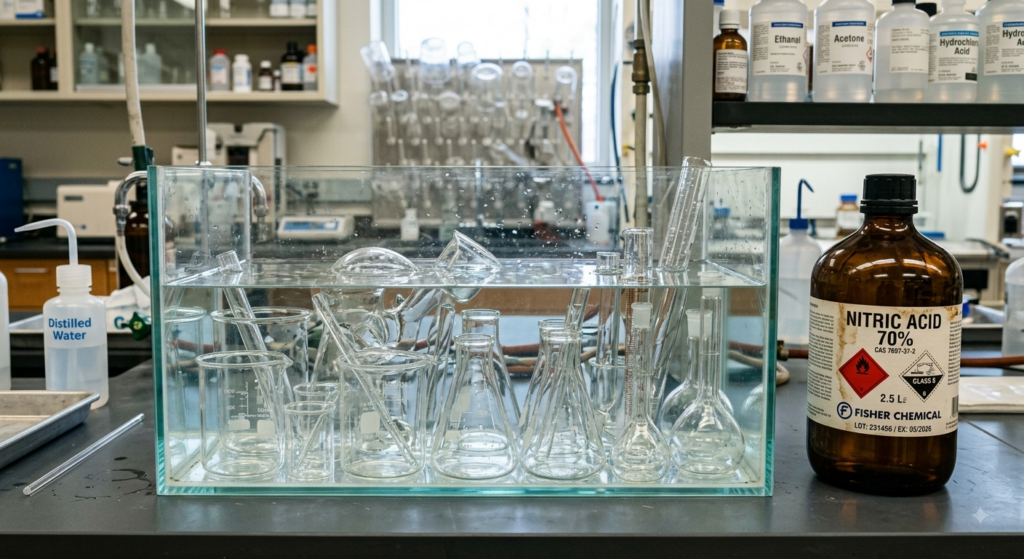
Soaking: Immediately submerge emptied glassware in room-temperature water to prevent organic residues from drying onto the glass walls.
2. Main Wash (Detergent Solution)
Scrub thoroughly using specialized non-alkaline, phosphate-free, or low-foaming lab detergents (e.g., 0.5%–2% Labolene or Alconox) dissolved in hot water.
Use soft nylon brushes with non-abrasive plastic or wire stems to prevent scratching the glass surface (scratches can harbor microorganisms).
3. Tap Water Rinsing
Flush the glassware thoroughly under continuous running tap water until all visible suds and soap films are removed.
4. Acid Washing (Targeted Treatment)
Apply appropriate acid solutions (detailed below) based on the specific type of contamination or new glassware processing.
5. Final Purified / WFI Rinsing
Rinse all internal surfaces at least 3 to 5 times with Purified Water (PW) or Water for Injection (WFI).
Verification: Water must form a smooth, uniform sheet on the inner glass surface rather than bead up (beading indicates residual grease or detergent residue).
6.Drying & Storage
Invert glassware on dedicated stainless-steel drying racks or place in a drying oven at 50°C–60°C.
Wrap cleaned items in aluminum foil or keep them in dust-free cabinets prior to autoclave sterilization or dry-heat depyrogenation