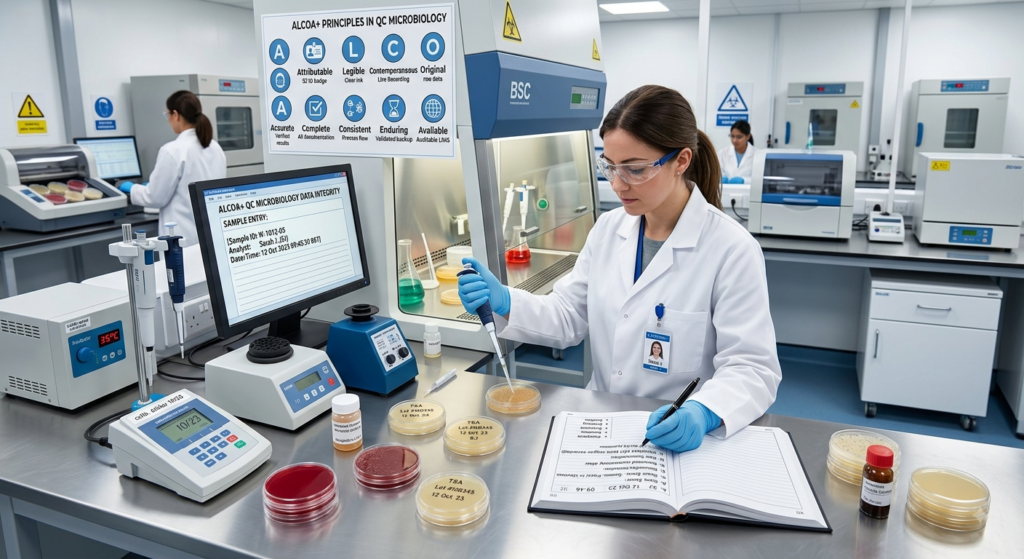
ALCOA+ is the foundational framework for Data Integrity in Good Documentation Practices (GDP) and Quality Control (QC) laboratories. Enforced by regulatory bodies like the US FDA, EMA, and WHO, it ensures that all laboratory data whether paper based or electronic is authentic, traceable, and reliable across its entire lifecycle.
The acronym builds upon the original five ALCOA attributes by adding four extra principles (“+”) to address complex electronic records and automated lab equipment.
Core principles of ALCOA+
A – Attributable: Every record, calculation, or signature must clearly identify who performed the action, on what date, and at what time.
QC Example: Unique user IDs on HPLC workstations; initials and timestamps on paper media logs.
L – Legible: Data must be readable and permanently recorded so it can be understood years later.
QC Example: Using indelible ink on raw data sheets instead of pencil; avoiding overwritten entries.
C – Contemporaneous: Results, weights, and observations must be documented at the exact moment the activity occurs, not reconstructed later.
QC Example: Logging pH or analytical balance readings directly onto the lab record immediately, rather than drafting on scrap paper first.
O – Original: The record must be the primary output or an officially validated “true copy”.
QC Example: Preserving raw printouts, instrument thermal papers, or native electronic metadata files (.raw / database entries) rather than transcribed summary notes.
A – Accurate: Entries must be error-free, truthful, and accompanied by controlled corrections if an error is made.
QC Example: Single-line strikethrough for paper corrections with a signature and reason; routine calibration of lab balances and equipment.