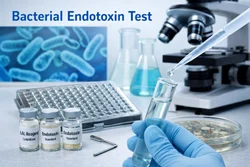
The bacterial endotoxin test (BET) is a crucial assay used to detect the presence of endotoxins, which are toxic components found in the outer membrane of Gram-negative bacteria.
Endotoxins can trigger severe immune responses in humans and animals, making it essential to monitor their levels in pharmaceuticals, medical devices, and other products that come into contact with the human body.
𝐏𝐫𝐢𝐧𝐜𝐢𝐩𝐥𝐞
Bacterial endotoxins are components of the outer membrane of Gram-negative bacteria. When endotoxins come in contact with Limulus Amebocyte Lysate (LAL) reagent, they activate a clotting reaction. The amount of clot formation or color/turbidity change is proportional to the amount of endotoxin present in the sample.
𝐌𝐞𝐭𝐡𝐨𝐝𝐬 𝐨𝐟 𝐁𝐄𝐓:
- 𝐆𝐞𝐥-𝐜𝐥𝐨𝐭 𝐦𝐞𝐭𝐡𝐨𝐝:
*A qualitative test based on the formation of a gel clot.
*If endotoxins are present above the specified limit, a firm gel clot is formed. - 𝐓𝐮𝐫𝐛𝐢𝐝𝐢𝐦𝐞𝐭𝐫𝐢𝐜 𝐦𝐞𝐭𝐡𝐨𝐝:
*Measures the increase in turbidity caused by the endotoxin-LAL reaction.
*The endotoxin level is calculated based on the change in turbidity. - 𝐂𝐡𝐫𝐨𝐦𝐨𝐠𝐞𝐧𝐢𝐜 𝐦𝐞𝐭𝐡𝐨𝐝:
*Measures the yellow color produced during the reaction.
*The intensity of color is proportional to the endotoxin concentration.
𝐏𝐫𝐨𝐜𝐞𝐝𝐮𝐫𝐞 (𝐠𝐞𝐧𝐞𝐫𝐚𝐥):
*Prepare the sample and required dilutions.
*Add LAL reagent to the sample.
*Incubate at the specified temperature (commonly 37 ± 1°C).
*Observe the reaction and calculate endotoxin levels.
*Compare results with the Endotoxin Limit (EL).
The endotoxin level must be within the limit specified by pharmacopeias such as USP, EP, or IP.