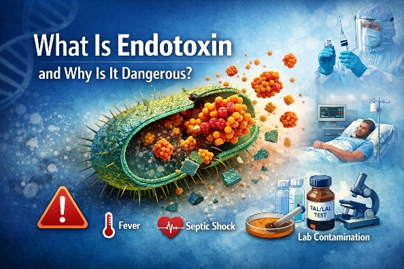
Endotoxin testing is crucial because bacterial endotoxins are highly toxic byproducts that can cause severe immune responses, fever, septic shock, and even death if they enter the human bloodstream or spinal fluid.
A sterile product can still be dangerous because sterility only guarantees the absence of living bacteria.
Endotoxins are lipopolysaccharides (LPS) released from the outer membranes of Gram-negative bacteria when they die. Because they are incredibly heat-stable, standard sterilization processes (like autoclaving or boiling) do not destroy or remove them. As a result, a product can be completely “sterile” (free of living cells) but still be fatally contaminated with bacterial debris.
𝐇𝐨𝐰 𝐢𝐬 𝐄𝐧𝐝𝐨𝐭𝐨𝐱𝐢𝐧 𝐓𝐞𝐬𝐭𝐢𝐧𝐠 𝐏𝐞𝐫𝐟𝐨𝐫𝐦𝐞𝐝?
The most widely used method is the Bacterial Endotoxins Test (BET) using the Limulus Amebocyte Lysate (LAL) test.
The LAL reagent, derived from the blood cells of the horseshoe crab, reacts with endotoxins.
If endotoxins are present above the acceptable limit, the product fails the test and cannot be released.
𝐖𝐡𝐲 𝐓𝐞𝐬𝐭𝐢𝐧𝐠 𝐢𝐬 𝐌𝐚𝐧𝐝𝐚𝐭𝐨𝐫𝐲
- 𝐒𝐭𝐞𝐫𝐢𝐥𝐢𝐳𝐚𝐭𝐢𝐨𝐧 𝐃𝐞𝐛𝐫𝐢𝐬: The sterilization process itself can cause dying Gram-negative bacteria to release endotoxins into the product. Testing verifies that these remnants were not left behind during manufacturing.
- 𝐒𝐨𝐮𝐫𝐜𝐞 𝐨𝐟 𝐂𝐨𝐧𝐭𝐚𝐦𝐢𝐧𝐚𝐭𝐢𝐨𝐧: Endotoxins act as biomarkers for past bacterial contamination, usually originating from contaminated water systems or raw materials during production
- 𝐑𝐞𝐠𝐮𝐥𝐚𝐭𝐨𝐫𝐲 𝐂𝐨𝐦𝐩𝐥𝐢𝐚𝐧𝐜𝐞: Global health agencies mandate Bacterial Endotoxin Testing (using frameworks like the USP <85> and ANSI/AAMI ST72) for product release and quality assurance.
𝐏𝐫𝐨𝐝𝐮𝐜𝐭𝐬 𝐑𝐞𝐪𝐮𝐢𝐫𝐢𝐧𝐠 𝐄𝐧𝐝𝐨𝐭𝐨𝐱𝐢𝐧 𝐓𝐞𝐬𝐭𝐢𝐧𝐠
- 𝐏𝐚𝐫𝐞𝐧𝐭𝐞𝐫𝐚𝐥 𝐃𝐫𝐮𝐠𝐬: Injectable medications, intravenous drugs, and vaccines.
- 𝐌𝐞𝐝𝐢𝐜𝐚𝐥 𝐃𝐞𝐯𝐢𝐜𝐞𝐬: Implants and devices that contact the bloodstream or cerebrospinal fluid.
- 𝐁𝐢𝐨𝐥𝐨𝐠𝐢𝐜𝐬: Insulin and other therapeutic proteins where microbial artifacts could trigger unwanted immune responses.
- 𝐖𝐚𝐭𝐞𝐫 𝐒𝐲𝐬𝐭𝐞𝐦𝐬: Water for Injection (WFI) and manufacturing inputs used in aseptic processing
𝐖𝐡𝐲 𝐄𝐧𝐝𝐨𝐭𝐨𝐱𝐢𝐧 𝐈𝐬 𝐇𝐚𝐫𝐝 𝐭𝐨 𝐄𝐥𝐢𝐦𝐢𝐧𝐚𝐭𝐞
One of the most challenging aspects of endotoxin control is its stability.
Endotoxin is:
IResistant to normal autoclaving
II. Stable across a wide pH range
III. Able to adhere strongly to glass, plastic, and metal surfaces
As a result, conventional sterilization alone is often insufficient. Specialized depyrogenation processes and validated testing methods are required to ensure safety.
Endotoxin is invisible, resilient, and extremely dangerous if left uncontrolled. Its ability to cause severe immune reactions, compromise research data, and threaten patient safety makes it one of the most critical contaminants in life-science industries.